
Introduction
A sudden twist, an awkward landing, or a high-impact sports movement — and your knee gives way. An ACL injury is not a minor setback. It disrupts mobility, weakens knee stability, and often sidelines individuals from sports, work, and daily activities.
Ignoring an ACL tear or relying only on temporary relief can lead to long-term instability and cartilage damage. If you are searching for ACL surgery in Gurgaon, accurate diagnosis and structured rehabilitation are essential for complete recovery.
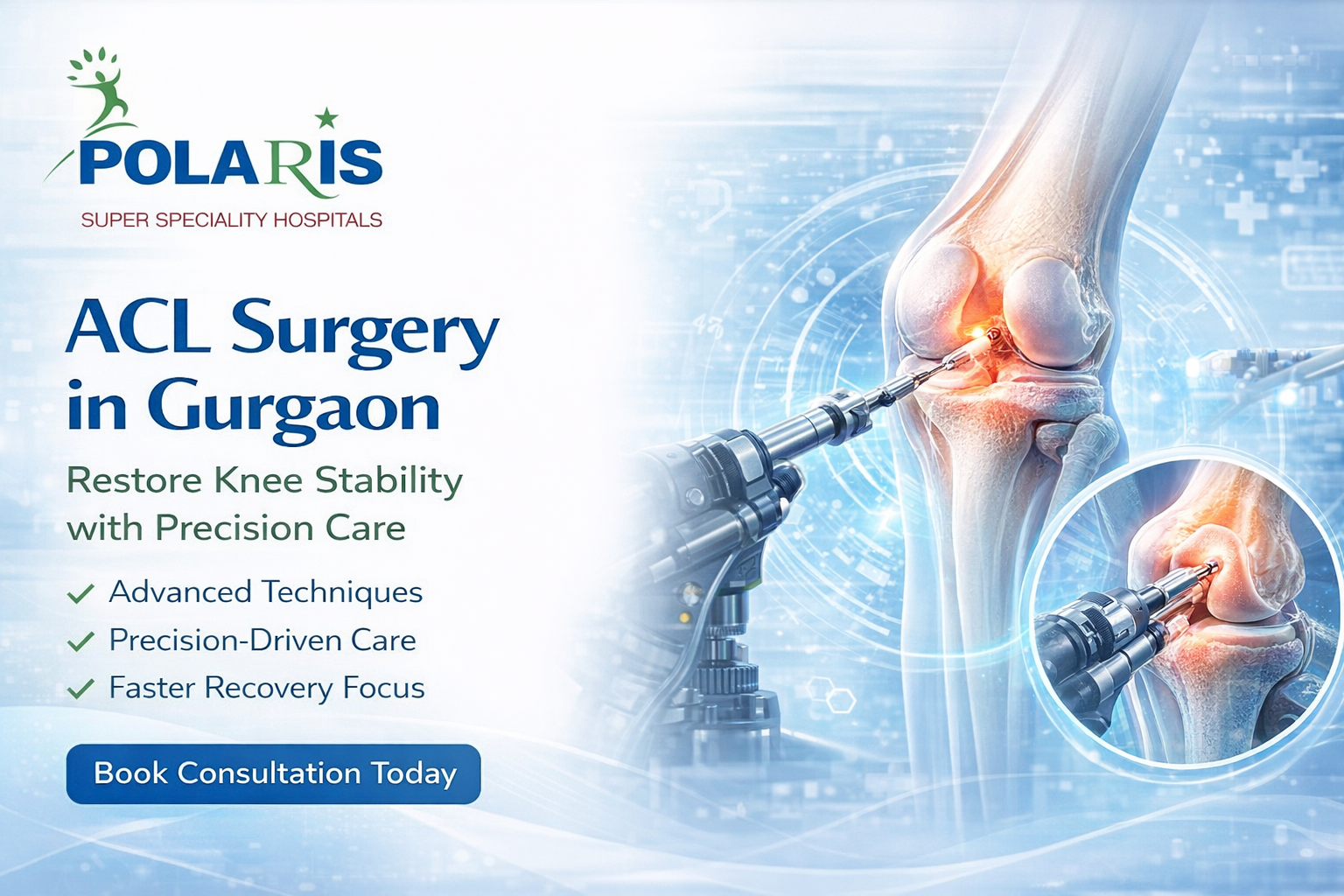
At Polaris Hospital, ACL reconstruction is performed using advanced arthroscopic techniques and outcome-focused care to restore knee stability and confidence in movement.
What Is ACL Surgery?
ACL (Anterior Cruciate Ligament) surgery is a procedure designed to reconstruct a torn ligament in the knee. The ACL is one of the primary stabilising ligaments responsible for controlling forward movement and rotational stability of the tibia.
When the ACL is torn, the knee becomes unstable — particularly during activities such as:
- Sprinting
- Sudden stops
- Pivoting movements
- Directional changes
During surgery, the damaged ligament is replaced using either:
- Autograft (patient’s own tissue — hamstring or patellar tendon)
- Allograft (donor tissue)
This reconstruction restores structural integrity and biomechanical stability.
Why Proper Treatment of ACL Injury Matters
An untreated ACL tear rarely heals naturally and significantly increases the risk of:
- Recurrent knee buckling
- Meniscus injuries
- Early osteoarthritis
- Loss of athletic ability
- Progressive cartilage damage
Timely surgical intervention helps protect long-term joint health and prevents secondary complications.
How ACL Surgery Works
Step 1: Diagnostic Evaluation
An MRI scan confirms the severity of the tear and identifies associated injuries such as meniscus damage or cartilage lesions.
Step 2: Graft Selection
Based on the patient’s age, lifestyle, and activity level, the surgeon selects the most suitable graft:
- Hamstring tendon autograft
- Patellar tendon autograft
- Allograft tissue
Step 3: Arthroscopic Reconstruction
ACL surgery is performed through minimally invasive arthroscopy. Small incisions are made, and a camera-guided system ensures precision placement of the graft.
Step 4: Fixation & Stability Testing
The graft is securely fixed and tested for tension, alignment, and knee stability.
This structured surgical approach ensures biomechanical accuracy and long-term functional outcomes.
Who Should Consider ACL Surgery?
ACL reconstruction is commonly recommended for:
- Athletes involved in pivoting sports (football, cricket, basketball)
- Patients with persistent knee instability
- Individuals with combined ACL and meniscus injury
- Active adults seeking return to physical activity
- Patients experiencing repeated “knee giving way” episodes
While not all ACL tears require surgery, reconstruction offers superior outcomes for active individuals.
When Is the Right Time for ACL Surgery?
Early surgical management is advised when:
- Swelling has reduced
- Knee motion is restored
- Instability persists despite physiotherapy
- The patient intends to return to sports or physical work
Delaying surgery for extended periods may increase the risk of additional joint damage.
Common Causes of ACL Injuries
ACL reconstruction is frequently required for injuries resulting from:
- Sports trauma
- Gym-related knee stress
- Road traffic accidents
- Occupational knee strain
Precise surgical repair restores movement confidence and knee stability.
Major Benefits of ACL Reconstruction
ACL surgery offers multiple functional and protective advantages:
- Restores knee stability
- Prevents further joint deterioration
- Enables safe return to sports
- Improves knee mechanics and strength
- Reduces future meniscus tear risk
- Promotes long-term joint health
- Minimally invasive with smaller scars
Structured rehabilitation further improves recovery predictability.
ACL Surgery vs Non-Surgical Management
| Parameter | ACL Surgery | Non-Surgical Treatment |
| Knee Stability | Restored | Often compromised |
| Risk of Future Injury | Lower | Higher |
| Return to Sports | Possible | Limited |
| Long-Term Joint Protection | Strong | Weak |
| Meniscus Protection | Improved | Risk remains |
| Functional Confidence | High | Moderate to low |
For active individuals, surgery is often the definitive solution.
Outcomes After ACL Surgery
Successful ACL reconstruction typically results in:
- Stable knee mechanics
- Progressive strength restoration
- Improved movement confidence
- Return to sports within months
- Reduced long-term joint complications
Recovery depends heavily on physiotherapy compliance and rehabilitation discipline.
Why Choose Polaris Hospital for ACL Surgery in Gurgaon?
Selecting the right centre directly influences surgical success and long-term knee function. Polaris Hospital provides:
- Advanced orthopaedic surgeons
- Modern arthroscopy systems
- Personalised treatment planning
- Comprehensive peri-operative care
- Structured follow-up & monitoring
The focus remains on measurable recovery and functional outcomes.
Localised Care Advantage in Gurgaon
Patients seeking ACL surgery in Gurgaon, particularly near Sector 48 and Sohna Road, benefit from:
- Convenient follow-ups
- Integrated physiotherapy programs
- Immediate medical support
- Continuity of care
Local access enhances recovery efficiency and patient compliance.
Advantages of Early ACL Reconstruction
Timely ACL surgery supports:
- Faster return to competitive sports
- Reduced secondary injuries
- Preservation of cartilage and meniscus
- Better long-term knee performance
Delays may compromise these benefits.
Frequently Asked Questions (FAQs)
What is ACL surgery used for?
ACL surgery reconstructs a torn anterior cruciate ligament to restore knee stability, prevent further damage, and enable safe return to activity.
Question.1 Is ACL surgery painful?
Post-operative discomfort is manageable with modern pain control protocols. Pain gradually reduces during recovery.
Question.2 How long is ACL surgery recovery?
Initial recovery takes a few weeks, while full return to sports typically occurs within 6–9 months, depending on rehabilitation progress.
Question.3 Can an ACL tear heal without surgery?
Complete ACL tears rarely heal naturally. Non-surgical management may suit low-activity individuals, but active patients usually require reconstruction.
Question.4 When can I walk after ACL surgery?
Most patients begin assisted walking within a few days. Weight-bearing progression follows surgeon-guided protocols.
Question.5 Is physiotherapy necessary after ACL reconstruction?
Yes. Rehabilitation is essential for restoring strength, mobility, and coordination.
Question.6 What happens if ACL surgery is delayed?
Delays increase the risk of meniscus tears, cartilage damage, and chronic instability.
Question.7 Is ACL surgery safe?
Yes. When performed by experienced arthroscopic surgeons, ACL reconstruction is highly safe and effective.
Conclusion
A torn ACL affects more than just the knee — it impacts mobility, performance, and long-term joint health. Ignoring instability can accelerate degenerative damage.
Precision-driven ACL surgery in Gurgaon provides a structured pathway toward stability, strength, and confident movement restoration.Precision-driven ACL surgery in Gurgaon provides a structured pathway toward stability, strength, and confident movement restoration.