
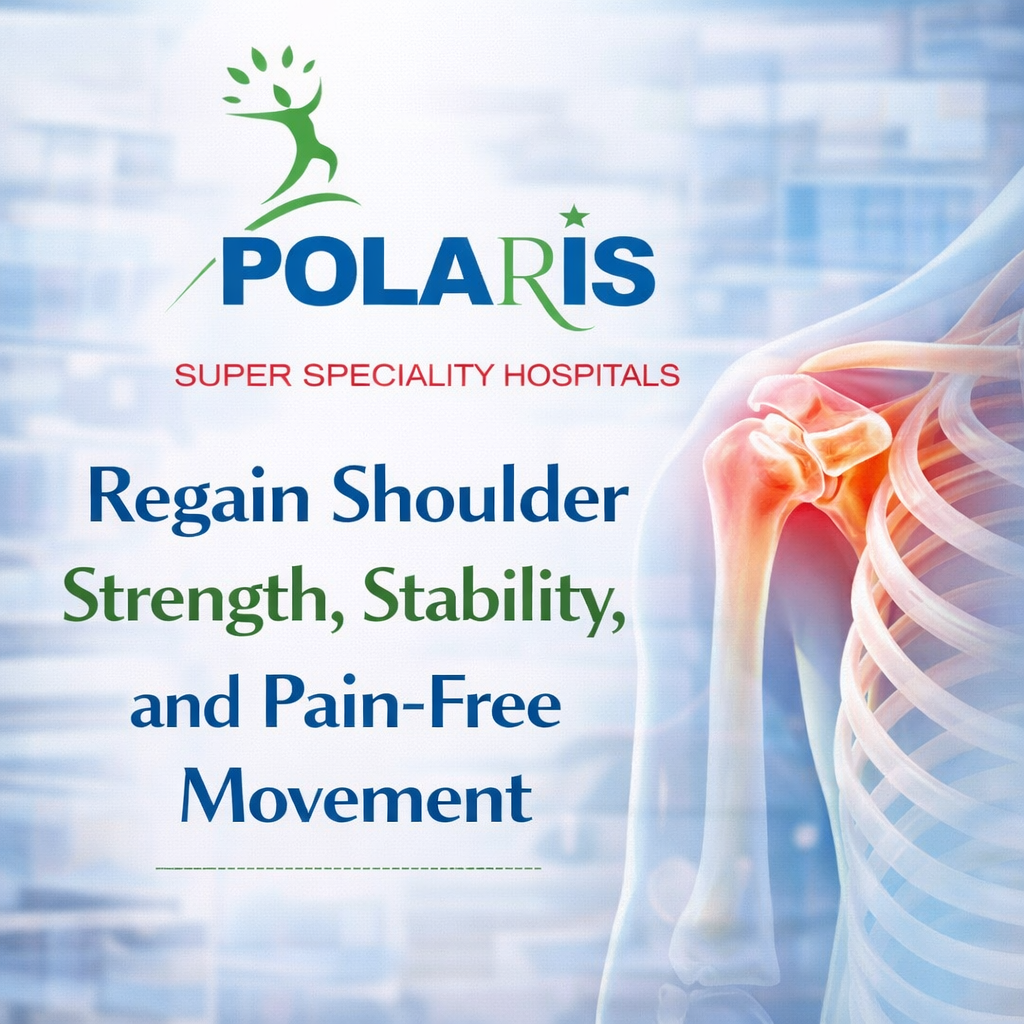
Shoulder pain is often ignored until it starts controlling daily life—difficulty lifting your arm, interrupted sleep, weakness while working, or sharp pain during simple movements. What many people dismiss as “normal strain” is frequently a rotator cuff injury that worsens over time. When conservative treatments prove ineffective, surgery really does seem the final solution to restore strength, stability, and long-term shoulder function. At Polaris Hospital, rotator cuff surgery is approached with precision, structured rehabilitation, and outcome-driven care focused on complete recovery—not temporary relief.
What Is Rotator Cuff Surgery?
Rotator cuff surgery is a highly specialized procedure done in orthopaedics to fix tendons that have ruptured or are damaged and help to stabilize the shoulder joint. The rotator cuff consists of muscles and tendons that support the act of lifting, rotating, and stabilizing the arm. When this set of tendons is ruptured, the patient gets weakness and pain in the region alongside a movement-restricted arm, which is likely.
The surgery is aimed at reattaching the torn tendons to the bone, re-establishing the mechanics of the joint, and preventing any further degeneration of the tendons.
Why Rotator Cuff Injuries Should Not Be Ignored
Rotator cuff tears do not recover on their own and should not be ignored for the following reasons:
Proper damage continues on the tendon.
Muscle gets wasted.
Permanent loss of shoulder power.
The longer a surgery is postponed, the more the success of it wanes.
Early surgery to avoid unnecessary harm to the joint and allow healing is key to achieving a remarkable surgical outcome.
- Elaborate imaging and diagnosis to gauge size and severity of tearing
- Surgical planning, based off patient’s age, activity level, and quality of tendon
- Minimally invasive versus open repair depending on complexity
- Secure reattachment of the tendon using anchor and sutures
- Structured rehab program to recover safely
The level of precision while performing the surgery directly affects the patient’s post-recovery strength and mobility.
Who Should Have Rotator Cuff Surgery?
Not every shoulder discomfort needs surgical treatment. However, surgery is recommended where structural damage is so severe that recuperation via nonsurgical procedures is precluded.
- Some of the best candidates include:
- Full-thickness tear in the tendon patients
- Patients with a history of pain persisting for 3 to 6 months
- Patients showing considerable muscle weakness in the shoulder
- Athletes or active individuals
People experiencing even more worsening symptoms that do not improve with physical therapy
In these instances, the late performance of surgery would decrease the chances of complete functional recovery.
When Not to Go for Rotator Cuff Surgery?
The timing is most crucial. If all of the following happens:
- pain interferes with sleep or normal living
- Shoulder malfunctions keep worsening
- The imaging work-up verifies deteriorating tear
Early intervention would prevent permanent retraction of the tendons and degeneration of the muscles, healing problems.
Cases Where Rotator Cuff Surgery Provides the Greatest Benefits
Rotator cuff surgery is of great benefit when treating:
- Repetitive occupational damage
- Sports injuries
- Degeneration due to years of getting older, resulting in torn rotator cuffs
- Traumatic injuries of the shoulder
With a correct diagnosis upon imaging, the surgeon has chosen another route to complete the surgery.
Which Rotator Cuff Tears Need Topsy-Turvy Surgery?
Surgery has been suggested only for the following rotator cuff tears:
- Full-thickness tears
- Broad debris involving tears, stunted muscle strength and fear
- Acute, trauma-induced tears
- Degenerative tears affecting function on a continuous basis
It is also related to the nature of the tear with respect to the difficulty of surgery and the time of recovery.
Major Benefits of Rotator Cuff Surgery
- Long-term relief of agony
- Strengthening the shoulder
- Faster recovery from muscle injury
- Muscle rejuvenation following fatigue or inactivity
- Weight loss
- Increased metabolism
Table Section: Surgical vs Non-Surgical Management of Rotator Cuff Tears
| Aspect | Rotator Cuff Surgery | Non-Surgical Treatment |
| Pain relief | Long-term | Often temporary |
| Tendon healing | Structural repair | No tendon repair |
| Strength recovery | Significant | Limited |
| Risk of progression | Reduced | High |
| Functional outcomes | Predictable | Variable |
| Suitability for active patients | High | Low |
Our executive rooms provide the easiest access to the luxurious amenities associated with a stay at Polaris Hospital. Why not put in a sitting arrangement while there?
Executive Patients May Experience Royal Treatment:
The waiting period, if any, is remarkable with a superior glass wall view overlooking the plush hospital campus
- An extremely cordial and courteous visit from the doctor(s) and staff
- Opulent leather sofa with high-resolution TV set for family entertainment
- A solid timber-wood coffee set with fine artwork on coffee or drinks tray
Such an elite setup elevates the critical segment of visiting the hospital to an ultra-luxury appointment.
Local SEO Focus: Rotator Cuff Surgery in Gurugram
Local access to advanced orthopedic care means that people looking for rotator cuff surgery in Gurugram will gain significant advantages. At Polaris Hospital, the population from Gurugram, Sector 48, and Sohna Road reaches the vicinity together with a couple more. Thus the hospital ensures that health services remain consistent for the patients concerned from the stages of diagnosis to rehabilitation.
One of the solid points in favor of local availability comprises
- Consistency in follow-up
- Coordination of physiotherapy
- Emergency assistance availability
- Timely Rotator Cuff Repair Introduces Several Opportunities
Getting the surgery done early boosts:
- Quick return to work and everyday life
- Adequate surgical repair
- Less management costs in the extended period
- Elevated capability for activities both on and off the field
Once a certain amount of time has passed, these opportunities are diminished.
(FAQs)
When is rotator cuff surgery needed?
Yes, it is important after rotator cuff surgery. A step-by-step rehabilitation program under guidance from a professional physical therapist assures a successful recovery.
Yes, as soon as you recover from the injury itself, you can start with physiotherapy. It is important for you to restore motion, strength, and joint stability, during which time you can see some “shutdown effect” of orthopedic hardware.
Can a rotator cuff tear heal without surgery?
Small or partial tears may be asymptomatic and improve with conservative management, but only if full-thickness tears or degenerative ones do not heal by themselves, ultimately getting worse without surgery.
When can patients return to work following surgery on the rotator cuff?
This depends on the different demands of the job. Jobs far from physical activity may lessen the time of incapacitation to just a few days usually, while jobs with athletic activity clearly require rehabilitation.
Are older patients suited for rotator cuff surgery?
Age is not a criterion; suitability for surgery will be determined as far as tendon quality, severity of pain, and specific functional goals are taken into account, not vis-a-vis an individual’s chronological age.
Conclusion
Perchance you are aware that rotator cuff injuries are most painful, limiting shoulder movement, thereby stifling daily independence, productivity, and the zest for life. Rotator cuff surgery offers a definitive and long-term answer when conservative treatments have failed. Recovery is certain and repeatable with the proper, precise diagnosis, surgical intervention, and structured rehabilitation.
Take care of your shoulders at the Polaris Hospital.